PREVIOUS MOSAIC EXHIBITIONS
Patricia and Phillip Frost Art Museum, USA
Until 22 February 2026
Art Newspaper
December 2025
Fragments of a mosaic floor that once adorned a ship belonging to Caligula, the tyrannical Roman emperor, have landed in Miami. The Frost Art Museum at Florida International University (FIU) is presenting the restored artefact along with 11th-century mosaic stone slabs. All are on view in the US for the first time, thanks to loans from the world’s oldest museum, the Capitoline in Rome. The exhibition, titled MOSAICO, unites these pieces with digital representations of major Italian mosaics that immerse viewers in intricate histories of ruin and repair.
&&&&&&&&&&&&&&&&&
Art Museum of the City of Ravenna
Chagall in Mosaic: from Project to Work
18 October 2025 - 18 January 2026
The first exhibition entirely dedicated to the relationship between Marc Chagall and mosaic art.
The exhibition inaugurates the 9th Ravenna Contemporary Mosaic Biennial, which from October will animate the city for three months with installations, exhibitions and widespread events. An event aimed at celebrating a millennial artistic language, capable of renewal and dialogue with the contemporary. The Biennial is conceived, organized and supported by the City of Ravenna - Department of Culture and Mosaic, with contributions from the Emilia-Romagna Region, Marcegaglia and the Fondazione del Monte di Bologna e Ravenna.
&&&&&&&&&&&
Vatican Micromosaics Permanent Exhibition
by Redazione
16 May 2025, etc .
"In the Pauline Hall of the Lower Galleries of the Vatican Museums the entire collection, consisting of nearly five hundred specimens, of micromosaics belonging to the pontifical patrimony has been permanently displayed. This extraordinary collection, once owned by Domenico Petochi, was acquired in the early 1990s thanks to the initiative of the then director Carlo Pietrangeli. Some of the works were already presented to the public in the major 1986 exhibition hosted in the Braccio di Carlo Magno. Today, however, the entire collection is on permanent display: placed inside the ancient cabinets of the Vatican Library."
&&&&&&&&&&&
Mosaic Arts International 2025
TIMELESS MOSAICS
Fine Art & Site-Specific Mosaic Art
SAMA’s Annual International Juried Exhibition
Presented at Albin Polasek Museum and Sculpture Gardens, Polasek Gallery, Winter Park, Florida
August 26 – December 7, 2025
&&&&&&&&&&&
Rite and Ritual
Mosaic exhibition by Elaine M. Goodwin
Biennale of Contemporary Sacred Art, Autun, Burgundy, France
18 July - 10 August 2025
Elaine was invited to exhibit in the 5th International Biennale
&&&&&&&&&&&
The Making of the Mottisfont Angel:
The Artistic Legacy of Boris Anrep
May 3 - July 13, 2025
Step into the world of Boris Anrep, the visionary artist behind some of Britain’s most celebrated mosaics. From the grandeur of the National Gallery to the intimate setting of Mottisfont Abbey, near Romsey, Hampshire, England. A National Trust venue and event.
Boris Anrep (1883 – 1969) is well known for his work in mosaics which decorate the National Gallery, the Bank of England and Westminster Cathedral. Two of his mosaics are also displayed at Mottisfont Abbey, the home of his patron and partner, Maud Russell.
Born in Russia, Anrep trained as an artist in France before coming over to Britain where he became a friend and associate of many members of the Bloomsbury Group. In Russia he also well-known as a poet, especially for poems addressed to fellow poet, Anna Akhmatova.
He met Maud Russell, the owner of Mottisfont Abbey in the 1930s and after the death of her husband Gilbert, they became romantic partners. Maud would go on to become his major patron, paying for the completion of his work at the National Gallery, and he in turn created portraits of her, including the Angel of Mottisfont which is still on display at the property.
On his death in 1969, Maud buried his ashes in Mottisfont’s garden before looking to establish his artistic legacy by gifting many of his sketches for mosaics and his correspondence to the Victoria and Albert Museum and Tate Gallery.
The exhibition looked to investigate this artistic legacy, tracing some of Anrep’s earliest works and relationships in Britain to his eventual relationship with Maud Russell.
BAMM North exhibition at Harlow Carr 1-23rd February 2025
BAMM North members annual mosaic exhibition at RHS Garden Harlow Carr, near Harrogate in North Yorkshire.
This year’s theme is Fable, Folklore and Fairytales
The Harlow Carr event is the jewel in BAMM North’s crown, attracting hundreds of visitors, raising interest in mosaic as an art form, showcasing the artists, both as a collective and as individuals, and generating many thousands of pounds worth of sales.
|
|
SEEING THE LIGHT
Elaine M. Goodwin Exhibition
St. George's Anglican Church
Campo San Vio
VENICE
Sunday 9th March 2025
to Sunday 30 March 2025
2-5.30 Wed, Thurs, Fri, Sat
A series of mosaic artworks celebrating light, selected for the Anglican Church of Venice. Each work uses the precious materials of Venetian gold leaf, mosaic glass smalti and Ravenna mosaic glass. Shimmering and joyous, they pay homage to a long history of mosaic for sacred spaces.
Elaine M. Goodwin is a world-renowned English artist who specialises in mosaic. Her work is found in numerous national and private art collections. She is a frequent international exhibitor.
https://elainemgoodwin.co.uk
&&&&&&&&&&&
New Voices in American Mosaics
The New England Mosaic Society
All Member Exhibition, is on exhibit now, through Dec. 14, 2024
at the Narrows Center for the Arts, 16 Anawan St., Fall River.
&&&&&&&&&&&
London School of Mosaic and Corner7 Gallery
OFFSITE
an exhibition of Contemporary
Mosaic Art
13 – 19 November 2024.
For more information please visit
https://www.lsomosaic.com/open-call-2024.
&&&&&&&&&&&
Chartres 2024
The 15th International Mosaic Exhibition
at Chartres runs from 19 October to 10 November.
The theme this year is "Urban"
&&&&&&&&&&&
Elaine M. Goodwin Exhibition
L’Esprit d’Azur
2 - 22 September 2024
Gallery: Salle St Esprit, Valbonne, Cote d’Azur
In the spacious exhibition chapel of the 13 th. century Benedictine abbey of Valboone, Elaine will exhibit a large selection of works inspired by this southern sea-bound region of France - the Cote d’Azur. The predominant colour of the exhibition will be blue - in all its scintillating hues - from deepest indigo blue to brightest celestial blue - all colours experienced in this famed region.
https://www.elainemgoodwin.co.uk
&&&&&&&&&&&
Elaine M. Goodwin exhibition
L’ éphémère - L’éternel
Galerie de L’Embarcadère
71300 Montceau-les-Mines, Burgundy
March 23 - June 1st 2024
A comprehensive exhibition of over 68 examples of Elaine’s mosaics created over the last 10 years. The works seek to answer many of the perennial questions artists have asked for centuries...What are we? Why are we here? What in fact is the meaning of life? These existential questions that underpin our lives are answered in her unique and personal way through the reflective materials of her medium of mosaic : gold and glass.
She uses a variety of images to explore these profound questions; the vine, the human figure; the sea and Nature in general.
The answers shimmer before our eyes; intriguing, ever changing, challenging and essentially celebratory.
&&&&&&&&&&&
Les climats de 4 artistes Bourguignon
24 May 2023 - 22 March 2024
Atelier d’Art Elaine M Goodwin, Couches, Burgundy
An exhibition bringing together four artists who live and work in Burgundy.
Exhibiting alongside Elaine are the painters Christophe Ropion, Christian Dejeune and sculptor/painter Jean-Paul Longin.
Each artist will work under the title with its emphasis on the word climat.
This word is exclusive to the wines growing areas of Burgundy; each vine is planted in a small, very specific parcel of land, where the characteristics of the wine depend on the position (terroir) and specific soil characteristics. The resulting wines are always nuanced, capricious, and above all - exciting. Accordingly the four artists are dependent on their specific, chosen environment and their individual and explorative vision but are united under the same luminous light - unique to the Burgundy region.
&&&&&&&&&&&
Bulgaria and Mosaics
Mobile Exhibition about Mosaic Heritage in Bulgaria
unveiled in Sofia
March 2024
Lurer.com | BTA. Mobile Exhibition about Mosaic Heritage in Bulgaria Unveiled in Sofia
&&&&&&&&&&&
MOSAICO: Italian code of a timeless art
The Asian tour of this exhibition starts in Vietnam. As a matter of fact, Hanoi will be the first city in Asia to host the multimedia exhibition dedicated to Italian mosaics, as conceived and realised by Magister Art and promoted by the Italian Ministry of Foreign Affairs and International Cooperation and the Italian Embassy in Hanoi.
The exhibition was conceived as a 2000-year-long journey through the images, symbols, techniques and materials of some of the most famous and representative Italian mosaics. Through an immersive multimedia experience, visitors will be able to admire the most striking mosaics of Rome, Pompeii, Aquileia, Ravenna, Palermo/Monreale, Piazza Armerina and Baia, along a step-by-step route.
The exhibition will be open from Friday 8 March to Sunday 7 April at the Vietnam Museum of Ethnology (Nguyen Van Huyen, Cau Giay, Hanoi).
&&&&&&&&&&&
Irish icons all over Manchester
in March 2024
Manchester artist's mosaic art trail celebrates Irish icons across city - BBC News
&&&&&&&&&&&
8th Biennial of Contemporary Mosaic
Ravenna, Italy
October 14th 2023 to January 14th 2024
The whole city is involved in a rich programme of events,
with its most charming places opening up to artists coming from all over the world.
Monuments, museums, cloisters and symbolic spaces become exceptional galleries,
where ancient and contemporary art meet and create a continuous dialogue.
Many events and guided tours will lead visitors to the discovery of a city
that has been and still is the undisputed Capital of Mosaic.
&&&&&&&&&&&
Timeless Mosaic Art in Transition
an International Mosaic Exhibition
in the cloister of Aldersbacher Abbey, Bavaria
May 20 - November 4, 2023
&&&&&&&&&&&
Reflection : Absorption
Elaine M Goodwin and Dugald McInnes
An exhibition bringing together the work of two artists
at the forefront of contemporary mosaic art.
17 June 2023 - 22 March 2024
Visits by appointment
at Atelier Elaine M Goodwin
4 Place de L'Église
71490 Couches
Burgundy, France
tél/sms: 06 67 96 62 56
email: studio@elainemgoodwin.co.uk
www.elainemgoodwin.co.uk
&&&&&&&&&&&&&&&&&&
Transitions
Mosaic Art Exhibition
hosted by Mosaic Artists of Canada (MAC) at the McMillan Arts Centre in Parksville, BC, Canada. A panel of expert jurors from around the world will ensure visitors will be treated to a stunning display of the best contemporary mosaic art that Canada has to offer.
Runs July 1st to August 27th, 2023
133 McMillan Street
Parksville, British Columbia V9P 1K7
&&&&&&&&&&&&&&&
Crown Celebration 2023
by South-West Mosaic Artists, England
Torre Abbey in Torquay will host our group exhibition to celebrate the King's Coronation. Fifteen mosaic artists have created artwork in response to this special event for our country.
The exhibition will run from 3 May to 31 July 2023.
Mosaic artwork will be on show by the following artists:
- Denny Dormer
- Kirsty Freeman
- Dawn Handy
- Audrey Hardman
- Alison Hepburn
- Manya McMahon
- David Nicholls
- Allan Punton
- Sue Smith
- Ali Soper
- Vita Sumieko
- Terry meets Julie
- Janet Ventre
- Adela Webb
- Pam Wilcox
Location: Torre Abbey, The King's Drive, Torquay, TQ2 5JE.
&&&&&&&&&&&&&&&
Coast & Country
BAMM NORTH Exhibition
Thursday 23 March–Sunday 16 April 2023
10am–4pm
Discover works by Yorkshire-based mosaic artists,
all members of BAMM – The British Association for Modern Mosaic.
&&&&&&&&&&&
‘Chanter le Blues’
('Singing the Blues’)
23 May 2022 - 24 March 2023
Atelier d’Art Elaine M Goodwin,
Couches, Burgundy
At varying times, life is affected by deep loss and suffering - it is an unquestioned characteristic of human existence.
The exhibition meditates on this intrinsically melancholic aspect of life and seeks to give visual antidotes - the beauty and stillness of a single vine; the luminous energy of a water fountain; the meditative nature of a silent sea - Images of solace.
&&&&&&&&&&&
Keeping It Small
Four Artists Exhibit 48 Miniature Mosaics
at Lyme Regis, England
The four are Alison Hepburn, Manya McMahon, Allan Punton, and Janet Ventre.
The exhibition, called Keeping It Small, will be at Lyme Regis Museum’s Rotunda Gallery
from Wednesday, December 7 until Sunday, January 15
Lyme Regis Museum is normally open Tuesdays through Sundays (Christmas opening times can be found at www.lymeregismuseum.co.uk).
&&&&&&&&&&&&&&&&&&&&
Constellations at Chester Cathedral
BAMM’s new exhibition Constallations, organised by BAMM North West
opens in Chester Cathedral
on 21st March 2022 and will run until 24th April 2022.
Visiting hours will coincide with the Cathedral’s schedule, so please go to their website to confirm before you visit - https://chestercathedral.com/opening-times/
(The Cathedral will be closed on Thursday 24th and Friday 25th March 2022
for graduation ceremonies.)
The exhibition will include the collaborative piece Ethereal, made by BAMM members.
More information about the exhibition is available on the BAMM website - https://bamm.org.uk/
&&&&&&&&&&&&&&&&
Fruits of the Forest
A British Association for Modern Mosaic Exhibition
by BAMM North
March 24th till April 24th 2022
at RHS Garden Harlow Carr, Harrogate, Yorkshire, England
The theme is Fruits of the Forest, and more than twenty Yorkshire-based mosaic artists will be exhibiting (and offering for sale) everything from mosaic badgers to birds, plus many other creatures, fruits and flowers that you might expect to find in the forest
and beyond.
The mosaic artists will be supporting the Yorkshire Wildlife Trust by producing a range of small mosaics – hares, butterflies and owls – and giving a contribution of sales to the Trust.
https://www.rhs.org.uk/gardens/harlow-carr/viewevent?EFID=3198&ESRC=CMS
&&&&&&&&&&&&&&&&&&
Mosaic Evolution
Sixty Mosaics
by
Fifteen Detroit Artists
14 January - 12 February 2022
Northville Art House, 215 W. Cady, Northville
Michigan, USA
More info at https://northvillearthouse.org/exhibitions/upcomingexhibitions/
&&&&&&&&&&&&
Washington & Lee University
Lexington, Virginia, USA
The Daily Ethics Mosaic Exhibition
10 January -
9 February 2022
Augusta Free Press
8 January 2022
'The Daily Ethics Mosaic is an exciting new feature of this year’s Mudd Center for Ethics program, “Daily Ethics: How Individual Choices and Habits Express Our Values
and Shape Our World".
This art project is a collaborative venture between the Mudd Center and Staniar Gallery.
W&L students, staff and faculty generated a large-scale community artwork in a series of workshops held during Fall Term 2021.
Workshops were led by Richmond-based artist Jonathan Lee, whose socially engaged art practice has guided innovative and inspiring community projects.'
W&L’s Staniar Gallery Daily Ethics Mosaic exhibition opens Jan. 10 (augustafreepress.com)
&&&&&&&&&&&&
Look Back and Smile
2 September - 14 November 2021
The British Association for Modern Mosaic (BAMM)
will be exhibiting at the Scott Gallery in Hawick in the Scottish Borders
to coincide with the celebrations
of the 250th anniversary of Sir Walter Scott's birth.
The Scott Gallery is part of Hawick Museum, an 18th century mansion which became home to the town's museum in 1910. It is the oldest museum in Scotland and a VisitScotland 4 star attraction. For more information about the location visit the Live Borders website
An online 'private view' of the exhibiton will be held on Friday 8th October
as part of the BAMM online forum weekend.
&&&&&&&&&&&&&&
Fragments of Light
an exhibition of mosaics
by Elaine M. Goodwin
Maison de la Culture, Diekirch, Luxembourg
8 May - 30 May 2021
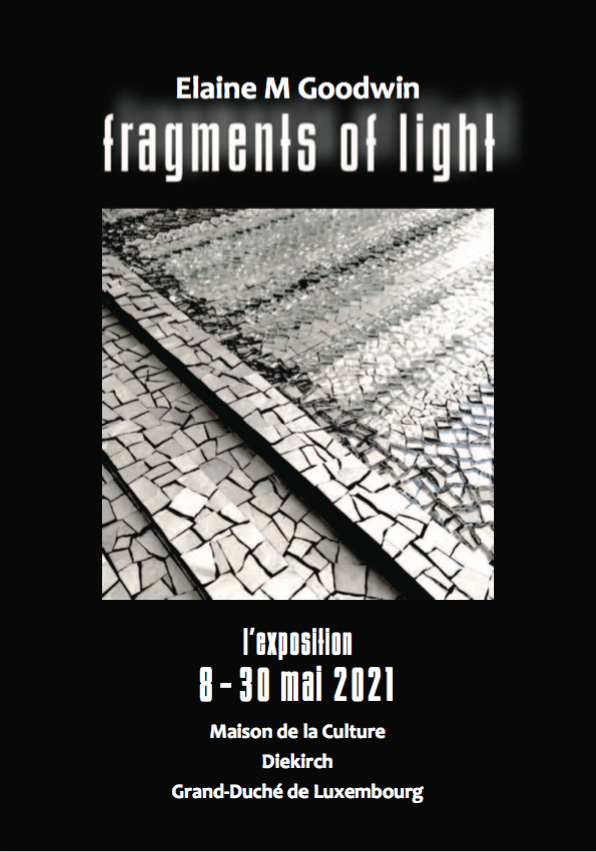
Created over the last ten years, each work in this new exhibition by the English artist Elaine M Goodwin, is composed with cut fragments of light-reflecting materials - precious mosaic golds and glass. The individually cut fragments (the tesserae), like words in a poem, play a vibrant and singular part in each completed work. The artist is constantly seeking out the wonder of life - a daily search for its essence. She explores nature and abstract concepts to enable the meaning of existence to be revealed and then translates what she finds into works redolent with light. Her artworks encapsulate moments of pure wonderment - to be experienced again and again in the ever changing surface of the works as the spectator looks deeper. It is a life-affirming vision...
&&&&&&&&&&&&&&&&&&&&&&&&
‘Il / Elle’ ‘He / She’
Exhibition by Elaine M. Goodwin
6 July 2020 - 30 April 2021

Galerie d’Art
4 Place de l’Église
71490 Couches
France
Open Sundays in the summer
from 2 pm to 6 pm
For visits at other times
phone: 09 86 42 38 60
www.couches.gallery
Artist’s statement “To look at ourselves: our Human Form, our depiction through art of ourselves in different times and cultures and to translate our looking into fragments of marble, and glass...and to return again to look... It can evoke both the eternal and the absurd!”
EMG 2019
For Goodwin, the representation of the “He” and the “She” was a progressive journey initiated by the history of sculpture, painting and mosaic. She has continuously explored expressions of the male and the female - and the intermingling of the two.
This exploration continues to absorb her,
and almost every year from the 1990s
to the present she has added a new work to a series alled He/She.
&&&&&&&&&&&&&&&&
Journeying to Light:
the Mosaics of Elaine M. Goodwin
Wed 10 April to Sun 23 June 2019
Royal Albert Memorial Museum
& Art Gallery
Queen Street, Exeter EX4 3RX, England
Open Tues to Sun, 10am to 5pm.
Closed Bank Holidays
‘My work is about light.
For all who look, at each and every moment, light is held, captured, and let go -
continually and continuously.
It is, for me, a sublime engagement.’
Celebrating 40 years of the mosaic art of Elaine M Goodwin,
this exhibition brings together over thirty luminous mosaics
to chart the experiences, places and beliefs that have inspired Elaine’s work.
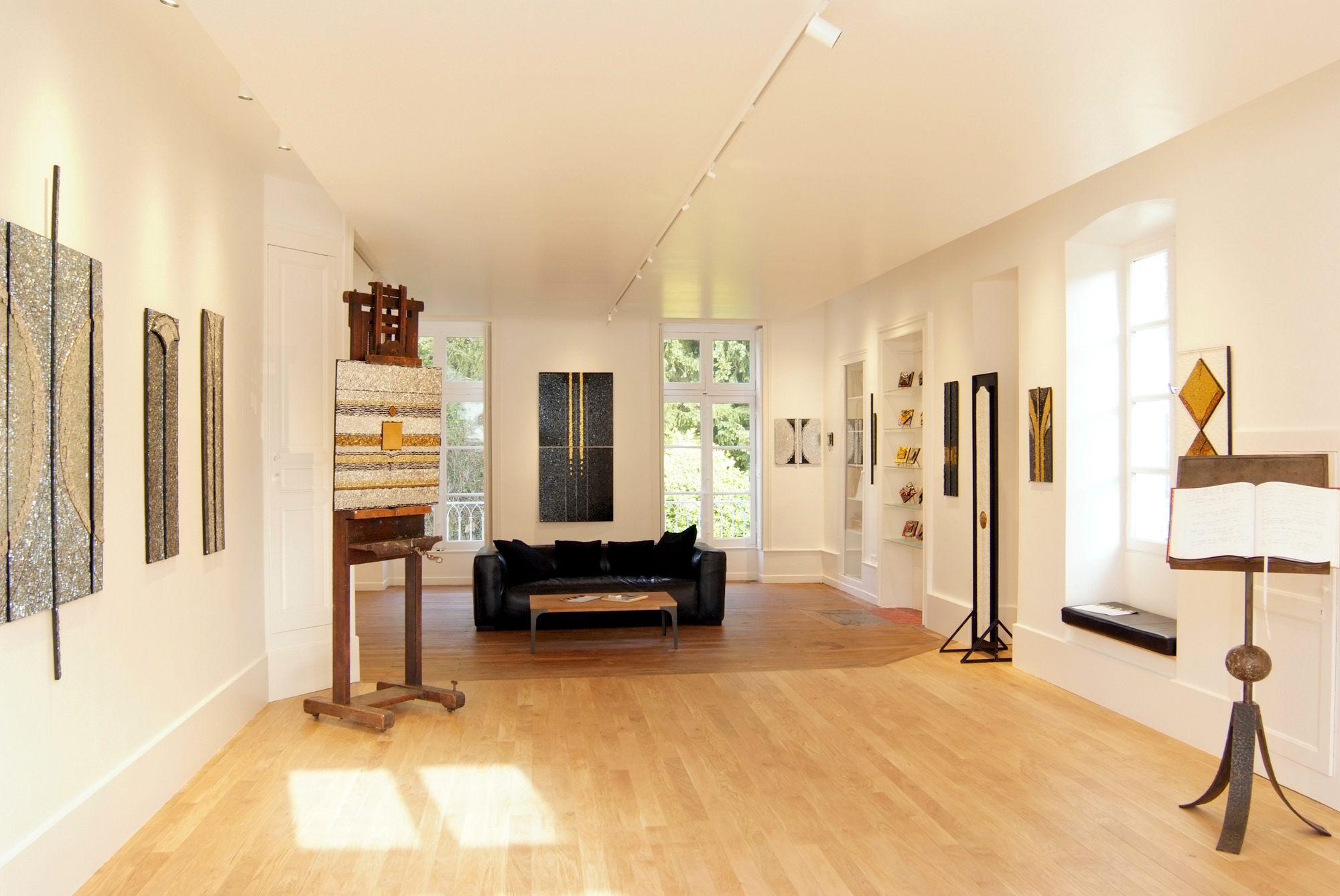
COUCHES GALLERY, FRANCE
TAKE FIVE
FROM SATURDAY 2 JUNE TO SATURDAY 20 OCTOBER 2018
This exhibition featured an improvised arrangement of new and recent works, both 2D and 3D,
by five very well-known international mosaic artists.
Lucio Orsoni, (Venice) Edda Mally (Austria) Annik Chaima (France)
Dugald McInnes (Scotland) and Elaine M Goodwin (England)
Works by five master-artists of mosaic from five different countries,
created a visually rhythmic and harmonic arrangement of colour, medium, shape and materials.
The result presented a discourse between light and shade,
the internal and the external, stillness and movement, depth and surface play.
Like a jazz quintet; individually each art work extolled a singular voice for mosaic
and together they sang of the wonders and magic within their medium.
Gallery address: 4 Place de L’Eglise, 71490 COUCHES, FRANCE
Telephone +33 (0) 986 423 860
For more information or to email visit:
http://www.elainemgoodwin.co.uk/index.php
2016 Spilimbergo Italy
XV International AIMC Congress:
May 18 - 21, 2016 Spilimbergo - Italy
The Mosaic in Contemporaneity
This very important AIMC event was held in 2016 in Spilimbergo,with the organizational collaboration of an exceptional institution: the Scuola Mosaicisti del Friuli.
for more information click here
Ravenna Mosaico 2015
Ravenna and the AIMC (International Association of
Contemporary Mosaicists) promoted the Fourth Edition of
the International Festival of Contemporary Mosaic,
Ravenna Mosaico.
The event took place from October 10 to November 8, 2015
and it hosted exhibitions, conferences, lectures, presentations of publications related to mosaic, and scientific studies related to the development of contemporary mosaic.
Glories in Gold & Glass
Mosaics & Ecclesiastical Art Study Day
St Paul's Cathedral Collections Department: Activities & Events
Friday, 13 November 2015
hosted
by the Museum of London
on the 13th November 2015
The mosaics in St Paul's Cathedral are one of the most unexpected and intriguing aspects of any visit. The scale and ambition of the scheme is awe-inspriting in itself. This study day looked at the wider context of the St Paul's Cathedral mosaics. Inspired by the renaissance of mosaic work in the nineteenth century which brought the vibrant colour and imagery to the walls and ceilings of St Paul’s, the speakers included:
Dr Heike Zech, Curator at the Victoria and Albert Museum: 'The Willaim Blake Richmond Mosaic Cycle at St Paul's'
Simon Carter, Head of Collections at St Paul's Cathedral: 'The Mosaics in a Collections Context'
Dr Ayla Lepine, Art and Architectural Historian: 'Stylistic Revivals in Nineteenth Century Church Interiors'
Lou Ashon, Conservator: 'The Conservation of the Fitzrovia Chapel mosaics'
Tessa Hunkin, Practising Mosaicist: 'Westminster Cathedral Mosaics Past and Present'
David Toothill, Artistic Director at Southbank Mosaics: 'Contemporary Mosaic Commissions in London'
A film premiere - The Making of the Queenhithe Mosaic
This Study was part of the St Paul's Mosaics Project
OTHER MOSAIC EXHIBITIONS
Ciel gallery and mosaic studio
in South Charlotte,
North Carolina, USA
The gallery offers monthly juried shows, each involving 30-40 different artists. It features both local artists and artists from all over the world who use an array of media, including jewellery, pottery, metal sculptures, paintings and glass mosaics.
All four gallery partners are working artists, each with a different speciality. Pam Goode, Teresa Hollmeyer and Vick Hanson-Burkhart are mosaic artists. Tina Alberni is a mixed artist who specializes in painting. They all offer classes and workshops in their areas of expertise.
Ciel also offers visiting artist workshops, providing local artists with an opportunity to learn from well-known artists from around the country.
Ciel Gallery and Mosaic Studio is at 136 E. Park Ave. in Charlotte.
For information click www.cielcharlotte.com.
Chedworth Roman mosaics to go on display
One of the longest in-situ Roman mosaics in Britain
is to go on display for the first time in 150 years at Chedworth
Roman Villa, Gloucestershire.
BBC News Gloucestershire
27 December 2011
Archaeologists uncovered the mosaic and others
as part of a £3m redevelopment. They said they had known
for many years there were more than those already on display
inside two Victorian-built timber sheds. The mosaics will go
on show inside a new conservation shelter at the site, which
is owned by the National Trust.
National Trust archaeologist Martin Papworth said
the mosaics had been seen and noted during Victorian excavations.
"Only two areas were put on display under the old shelters,"
he said. "However, when we did some work to check on their
condition we were concerned that frost and weather were affecting
them and it was agreed they could be better protected by building
a new environmentally controlled shelter over that whole section
of the villa and excavating them for display."
The mosaics include one of the longest in-situ corridor mosaics
in the country, which is 35m (115ft) long. It will go on display
under a special walkway allowing visitors to walk just above
the Roman floor. One remaining section of the corridor mosaic
will be excavated next summer.
Conservator Chris Cleere said: "The mosaics
were wet when they were excavated and now they are safe inside
the new building we will let them dry out and see what happens.
Then we can assess what type of work we need to do over next
summer for the long term conservation. In the short term we
will clean the mosaics, stabilise them and prepare them for
display to the first visitors."
The new conservation shelter, a redeveloped visitor
facility and a new education centre will be officially opened
on 4 March.
Mosaic artworks go on display in "Green
Garden"
More than 125 mosaics can be found in the sunken garden on
Loch Promenade, Douglas, Isle of Man
by Tessa Hawley
isleofman.com
August 2011
They are part of an initiative called "Garey
Glass – Green Garden" which aims to encourage environmental
responsibility. The sunken garden has a "recycle-reuse-reduce"
theme and as well as the mosaics, which have been made using
recycled material, features a pathway constructed from recycled
bottles.
Community arts specialist Debra Tracey worked
with local charities and voluntary groups to create the mosaics
for the garden. She said: "Garey Glass has been a tremendous
community effort involving people of all ages and abilities.
"I held a number of work sessions in the
run up to the launch and it was wonderful to see whole families,
from very young children to grandparents, getting involved with
making the mosaics - every single piece of which has been used
which makes the project truly inclusive.
"We've used as much recycled material as
possible, right down to the jars and containers for the eco-art
classes, and we found all kinds of creative ways to reuse plastic
carrier bags - even for making the 'ribbon' cut by the deputy
mayor at the opening."
Chris Pycroft, development manager for the Douglas
Development Partnership said: "Garey Glass has brought
added interest and a new sense of community to the sunken gardens
which are magnificently maintained by the council's parks section.
"The mosaics will bring colour to the garden
during the months when the flowers have died down while the
LED lighting gives life to the space at night so this is very
much a garden for all seasons and all hours."
The project has been funded by the environmental
charity Groundwork which uses the profits of the Marks and Spencer
carrier bag charge and Douglas Borough Council and the Douglas
Development Partnership.
TE-21 EXHIBITING GROUP LAUNCHED
TE-21 (Tessellated Expression for the 21st century),
a new exhibiting group, was launched in Chartres, France, on
25 October 2008 by four mosaic artists, each internationally
recognised. They were Elaine M. Goodwin (England), Dugald MacInnes
(Scotland), Lucio Orsoni (Italy) and Toyoharu Kii (Japan).
The launch took place under the aegis of the Association
Les 3R, which organises the biennial Rencontres Internationales
de la Mosaique in Chartres.
Lucio Orsoni of Orsoni Mosaics fame spoke animatedly
of proposals for future exhibitions. Dates have yet to be arranged
but watch this space!
To learn more about TE-21 see our News
Item on the launch of the group.
Source: Solo
Mosaico
THE GILBERT COLLECTION
AT THE VICTORIA & ALBERT MUSEUM
LONDON
This outstanding collection of decorative art is
one of the most important bequests ever made to the British nation.
It was the gift of Sir Arthur Gilbert, who was born in London and
settled in California in 1949. The collection was originally displayed
in Los Angeles but then found a home for some years in the palace
of Somerset House, on the north bank of the Thames by Waterloo Bridge.
This magnificent building used to be the home of the Inland Revenue,
but happily the taxman made way, first for the Courtauld Collection,
and then for this magnificent addition, Sir Arthur's collection
of European silver, gold snuff boxes, furniture, clocks, miniatures
- and Italian mosaics. These treasures are now to be seen at the
V&A Museum.
The mosaics are of two kinds; Florentine "pietra dura"
(opus sectile miniature pictures made of plain and polychrome marble
and semi-precious stones) and micro-mosaics. These evolved in Rome
in the late 18th century as souvenirs for rich tourists making the
Grand Tour. The glass threads of which they are made are so small
as to be barely visible as individual tesserae.
To see more about Sir Arthur Gilbert, his life and the
collection go to our Gilbert
Collection article on the feature pages.
|
|
|