
Scroll down the list for other articles.

A scheme to finish off Westminster Cathedral

April 2010

Paul Bentley


Back in 2008 the Catholic Herald published a scheme for the mosaicing of the main areas of Westminster Cathedral, but added that the decoration had been put on hold for two years while restoration work was carried out. Well, the two years are up, the repairs are done, so it's reasonable to assume that the Cathedral's Art & Architecture Committee is indeed considering getting on with big job - all 8000 square metres of it. That's to say, commissioning someone to design and make the mosaics. There has however been no official announcement as yet. So perhaps it's a good time to remind ourselves of the Catholic Herald article and the details of the Langham scheme.

Scholars unveil decoration plans for Westminster Cathedral

Catholic Herald
23 May 2008
by Mark Greaves

SOME of Britain’s leading Catholic scholars have prepared a blueprint for the decoration of Westminster Cathedral.

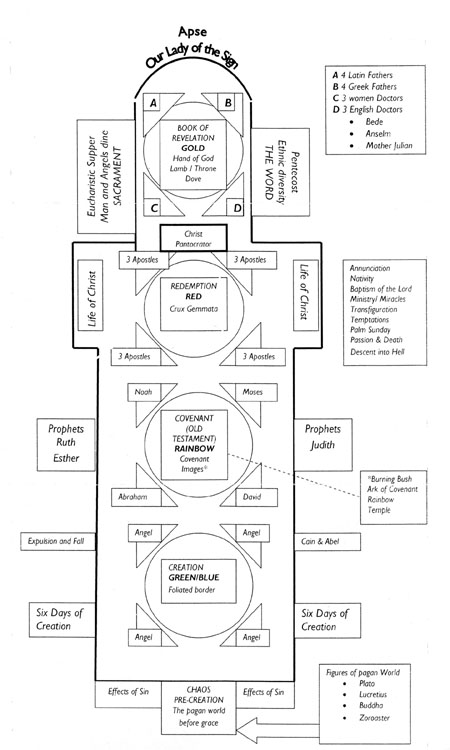
The design, modelled on Byzantine churches in Italy, provides a guide for covering the Cathedral’s immense ceiling with mosaics. At present almost 90 per cent of the interior brickwork remains bare.

It begins with the creation of the world at the front of the cathedral and culminates at the building’s east end with the return of Christ and the establishment of the Kingdom of God. Its vast eschatological sweep is emphasised by a pattern of colour that proceeds from green and blue through to red and finally, at the consummation of the world, to gold. Alongside pagans such as Plato, Lucretius and Zoroaster, the design also includes a representation of Buddha.

The blueprint, which still needs final approval, was hammered out over several meetings by Mgr Mark Langham, the former administrator of the cathedral, Fr Aidan Nichols, a theologian at Oxford University, Dr Eamon Duffy, a historian at Cambridge, and Andrew Wilton, a distinguished art historian and research fellow at Tate Britain.

The decoration of the cathedral has been put on hold for two years while £3 million worth of restoration work is carried out to the brickwork and electrical system. It is understood that a donor has given £500,000 to fund the repairs so that work can begin more quickly in decorating the apse with mosaics. Seven of the 11 side chapels have been decorated since the Cathedral was built in 1903 but no work has yet been done on the domes and main ceiling.

The world’s grandest scheme of Byzantine mosaics can be found at St Mark’s Basilica, Venice, and focuses solely on representing the life of Christ.

The Westminster blueprint is partly modelled on this scheme but also introduces a number of modern elements, including a stronger representation of women. The three women Doctors of the Church — St Catherine of Siena, St Teresa of Avila and St Thérèse de Lisieux — are grouped together in the fourth dome representing the return of Christ. The medieval mystic Julian of Norwich, who has not yet been canonised, is also presented in this final dome as one of the English Doctors of the Church.

Dr Eamon Duffy, Professor of the History of Christianity at Magdalen College, Cambridge, said that devising a scheme for the Cathedral was a “terrifying responsibility”. “It is a great building and a lot of people are attached to its holy gloom,” he said. “Also, modern mosaic schemes are often frightful, like something out of Walt Disney.”

He said they wanted to replace the randomness of most church decoration with a system that was logical and that reflected the structure of the Bible and the liturgy.

“In a lot of Catholic churches there is no particular reason why it should be one saint rather than another, and what we wanted was a frame work that had an inner logic to it. We felt it should be catechetical and that it should unfold as you walk through the cathedral from one end to the other,” he said.

Dr Duffy said that the depiction of pagan figures conformed to traditional Christian art and pointed to the prominent role of pagans in Dante’s Divine Comedy. He explained: “Dante was led by Virgil [the Roman poet] and he finds the great pagan teachers in a place of non-suffering.”

Fr Aidan Nichols, the John Paul II Memorial Visiting Lecturer at Oxford University, said the scheme was meant to be inspiring as well as useful for catechesis. He explained that the pagan figures were represented because they had “pointed to revealed truth”.

The Cathedral’s architect John Francis Bentley had intended to fill the ceiling and domes with mosaics but he died before he could devise a scheme. In England at the time there were few mosaic experts and so famous painters such as John Singer Sargent and Sir Lawrence Alma-Tadema were asked to consider designs for particular chapels.

Neither of them took up the offer and instead the first mosaics were designed by an unknown artist called W C Symons. His mosaics were the only ones present when the Cathedral first opened and can still be seen in the Holy Souls Chapel.

It is estimated that covering the Cathedral in mosaics would take at least two and a half years and cost about £12 million.

****

April 2010 - Mosaic Matters Editor Paul Bentley writes –

My reaction to this scheme was that I hoped it wasn’t going to be the sole submission before receiving final approval. For example, why should the scheme be “catechetical”? That was the approach in the Middle Ages, when people couldn’t read. Nowadays being catechetical is a job for a catechism, catechists and the clergy; a cathedral’s task is to inspire worshippers with a sense of the glory of God.

And in what way is this scheme “logical” if the Effects of Sin precede the Fall? Not to mention Plato, Lucretius, Buddha and Zoroaster.

And giving two-thirds of the nave to the Old Testament means cramming the whole earthly life of Christ into the transepts.

Again, the scheme omits Old Testament/New Testament parallels, such a prominent feature of Mass readings and indeed of church iconography over the centuries.

And how does the Langham scheme embody the primary dedication of the Cathedral to the Precious Blood?

Technically also domes of green, blue and red are heavy and oppressive (as in St. Paul’s in London and St. Louis in the USA), which is why Middle Byzantine domes principally used light colours and gold, with its astonishing ability to find the light.

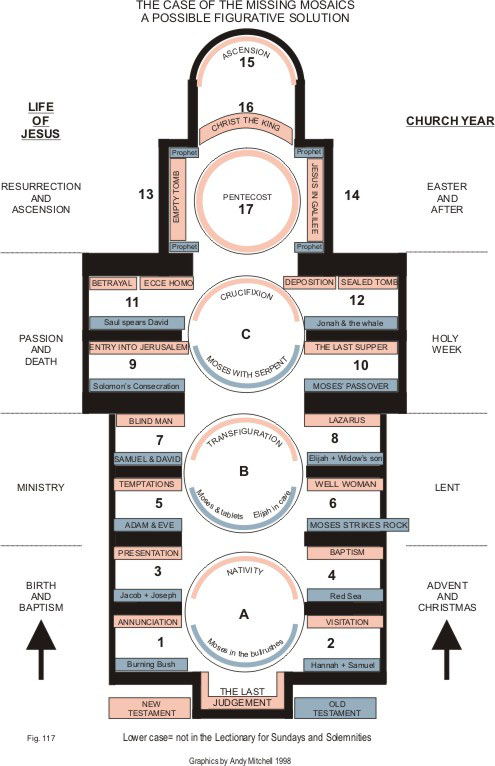
I append my own scheme for a mosaic scheme for the Cathedral. In contrast to the Langham scheme it is very much Christ-centered.


All of which said, personally I strongly favour a non-figurative design, as in Justinian’s mosaic decoration of the greatest church in Christendom, his Saint Sophia in Constantinople.

My principal reason for advocating a non-figurative design is that over the years we have come to appreciate that what is magnificent about Bentley's building is the form above all, and if the upper half were covered with scores of figures, in whatever style, the form would inevitably take second place. This is for example what happened in St. Mark’s in Venice: you see the mosaics first, and much later the architecture, the ceiling is too busy. So my solution for Westminster would be to have a traditional Byzantine gold ground, enriched with crosses, other Christian symbols and abstract patterns, as in the original sixth century mosaics of Saint Sophia (the existing figures there are ninth century).

As for the idea that the mosaics ought to be catechetical, then non-figurative Saint Sophia is a powerful rebuttal; that church was its own iconography, so to speak; it was supremely a sacred space. (If anyone had suggested to Emperor Justinian that the mosaicing of Sophia was “just decoration”, he would have found himself instantly posted to one of the remoter regions of the Empire.) The gold ground of course contributed greatly to the sense of the divine.

To quote an essay I once wrote on the subject, ‘Even in the earliest days of Christian wall mosaics, gold was used as a metaphor for light, above all for the Divine Light. We first met gold tesserae, if you recall, in the halo of Christ the Sun God in the third century tomb beneath St. Peter’s, Rome. Among Eastern theologians St. Basil and Pseudo-Dionysius both used gold as a sign of light and divinity, and Byzantine theologians generally “interpreted gold as condensed light, as the symbol of incorruptibility, truth, glory, and of the sun”. Gold was the purest, the most precious metal, and did not rust or decay. So it was that gold, of all earthly materials, was best suited to invoke the transcendental nature of Christ the Light of the World’.

The gold ground also had the effect of unifying the entire space, so that all the surfaces seemed to flow one into another. As Swift put it, “The gold contributes to the immaterialization of the vault surfaces and destroys the effect of weight in the vaults themselves, an impression considerably heightened by the diagonal lighting from the windows of the dome and half-domes".

I would also argue that a non-figurative “abstract” design can in itself be powerfully spiritual. I don’t mean designs with crosses and traditional Christian emblems, I mean the actual abstract design and its expression.

Paul Bentley

P.S. A couple of corrections to the Catholic Herald article: nine of the twelve chapels have been mosaiced to date, not seven; and the figure £12 million was valid in my 1999 Daily Telegraph article (the reporter’s source), but in 2010 it’s more like £25 million, based on what mosaicists charge per square metre for designing, making and installing a smalti mosaic.


All content is copyright of © Mosaic Matters and its contributors.
All rights reserved

Mosaic Matters is:
Editor: Paul Bentley
Web Manager/Designer: Andy Mitchell